I love little craftsman houses with the dormers that look like an eyelid in the process of opening. One house like that was torn down in Searcy just a year or two ago. Photo of that one after the jump.
Showing posts with label Searcy. Show all posts
Wednesday, February 29, 2012
Monday, November 15, 2010
Setting the Tracks Straight: III
At last, the most glorious of Searcy's depots!
The Rock Island railroad originated in a town of the same name in northern Illinois. I believe the part that came through Searcy was a spur that terminated right at the edge of downtown. The depot was right across the street from Spring Park, a destination for many travelers to Searcy in its pioneer days.

The Rock Island depot was notable because it was brick and expensive. No one was really sure why the railroad built such an extravagant building in Searcy, because the town wasn't exactly a major destination for the railroad, even with the sulphur spring. But build it they did.
I love to imagine the geography and feel of the town when all three of these railroads were operating in its borders. Imagine hearing those steam locomotive whistles every few hours? And being able to hop on a wooden M&NA car and taking a scenic trip up to Pangburn or Letona? Assuming it came in on time.
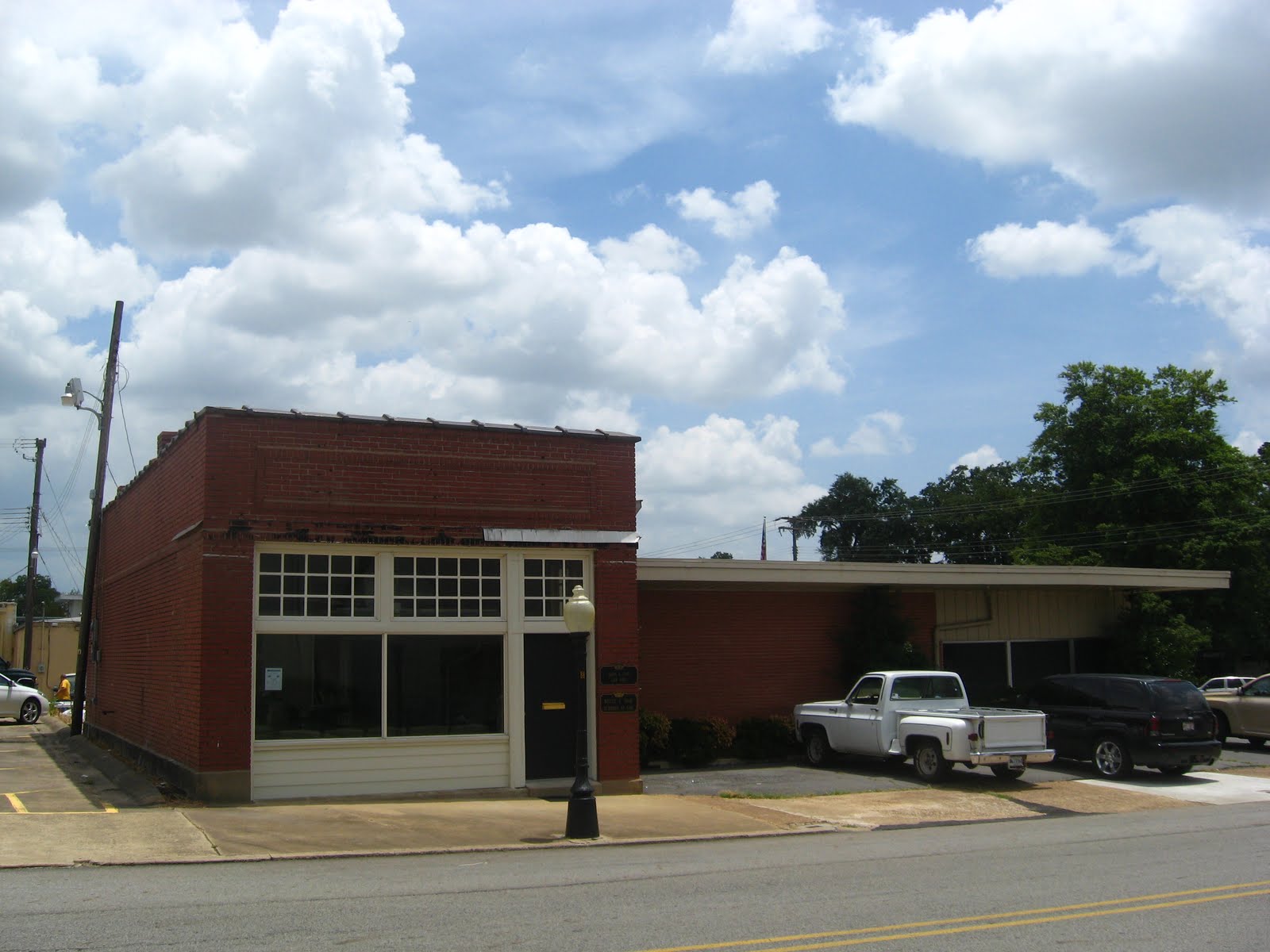
The Rock Island depot was turned into a car dealership for a while in the 1960s, but sometime in that period it was demolished. Here is the same location now from the above picture:

The brick building on the left is a law firm, but if you study the historic photograph, you can see that it was once a ticket office.
By far the most ironic thing to me about these buildings is how Searcy struggled to get the railroads to notice it while other towns nearby like Kensett, Judsonia and Beebe reveled in the major arteries passing right through them. But now nobody goes to Kensett, Judsonia or Beebe, and they still have those rails.
Hm.
-Jonesy
The Rock Island railroad originated in a town of the same name in northern Illinois. I believe the part that came through Searcy was a spur that terminated right at the edge of downtown. The depot was right across the street from Spring Park, a destination for many travelers to Searcy in its pioneer days.

The Rock Island depot was notable because it was brick and expensive. No one was really sure why the railroad built such an extravagant building in Searcy, because the town wasn't exactly a major destination for the railroad, even with the sulphur spring. But build it they did.
I love to imagine the geography and feel of the town when all three of these railroads were operating in its borders. Imagine hearing those steam locomotive whistles every few hours? And being able to hop on a wooden M&NA car and taking a scenic trip up to Pangburn or Letona? Assuming it came in on time.
The Rock Island depot was turned into a car dealership for a while in the 1960s, but sometime in that period it was demolished. Here is the same location now from the above picture:
The brick building on the left is a law firm, but if you study the historic photograph, you can see that it was once a ticket office.
By far the most ironic thing to me about these buildings is how Searcy struggled to get the railroads to notice it while other towns nearby like Kensett, Judsonia and Beebe reveled in the major arteries passing right through them. But now nobody goes to Kensett, Judsonia or Beebe, and they still have those rails.
Hm.
-Jonesy
Setting the Tracks Straight: II
Continuing in the discussion of Searcy's depots. I don't know which of the other two came first, but I can definitely tell you which one was demolished first. The Missouri & North Arkansas line, which I've also discussed several times before, was a north-south line from Eureka Springs to Helena. It was plagued by a cluster of developmental problems, and ceased operations through Searcy in the mid 1940s.

The quaint little wooden depot was characteristic of the M&NA. Few of them still remain. The picture was probably taken around 1905 or so - take a look at the horses and folks. A passenger car very much like the one picture is on display in Bald Knob. Almost no evidence of this part of Searcy remains to this day.
But, if you walk down Mulberry Street, the little spur road off of Beebe-Capps and Main, you might notice some rails poking through the asphalt. This is the old M&NA roadbed. A few other bits of evidence still stand nearby, like loading docks on sheds and the ruins of an old motel.

I'm not terribly certain, but I have a hunch that the old Kelso Feed Store stood in the same place the M&NA depot was. It was demolished about a month ago after a long period of neglect and abandonment.
-Jonesy
The quaint little wooden depot was characteristic of the M&NA. Few of them still remain. The picture was probably taken around 1905 or so - take a look at the horses and folks. A passenger car very much like the one picture is on display in Bald Knob. Almost no evidence of this part of Searcy remains to this day.
But, if you walk down Mulberry Street, the little spur road off of Beebe-Capps and Main, you might notice some rails poking through the asphalt. This is the old M&NA roadbed. A few other bits of evidence still stand nearby, like loading docks on sheds and the ruins of an old motel.

I'm not terribly certain, but I have a hunch that the old Kelso Feed Store stood in the same place the M&NA depot was. It was demolished about a month ago after a long period of neglect and abandonment.
-Jonesy
Setting the Tracks Straight: I
I keep coming back to the Searcy depot.
My problem was, I didn't realize it should have been depots, the plural. In the late 19th century, Searcy was bypassed by the major railroad (the Cairo & Fulton, at the time). Town leaders struggled to get the live-giving metal rails to pass through this town, and they finally did - but Searcy was still a bit off the beaten track. So at various times, Searcy had three unique railroads, each with their own station, passing through.
1. The Doniphan, Kensett & Searcy Railroad
This was the first railroad to make it through the town, and it was an extremely short line. "Doniphan" doesn't even really exist anymore as a town, being mostly just a location between Searcy and Kensett. In its early days, the DK&S was a wooden tram line between Kensett and Searcy.
Oh, and no locomotives traveled it. Instead, passengers rode on a flat cart pulled by mules. Yep.
Here's that depot:

The DK&S went through multiple owners and identities, finally being absorbed by the supermassive Union Pacific Railroad. Ironically, though it was the smallest railroad in town, it's the only one with any tracks left. The tracks leading down Park Avenue past the Cloverdale area is the original roadbed leading from Kensett.
In fact, it's probably because Upac owns the building that it still stands today:

The wooden surface sticking out on the left is the freight loading dock. It would seem that the DK&S building was once about twice as long, judging by the older picture, but it was never the town's most glamorous station. This area was once the town's booming industrial area, home to strawberry packing and a prosperous shoe factory.
Two more to come!
-Jonesy
My problem was, I didn't realize it should have been depots, the plural. In the late 19th century, Searcy was bypassed by the major railroad (the Cairo & Fulton, at the time). Town leaders struggled to get the live-giving metal rails to pass through this town, and they finally did - but Searcy was still a bit off the beaten track. So at various times, Searcy had three unique railroads, each with their own station, passing through.
1. The Doniphan, Kensett & Searcy Railroad
This was the first railroad to make it through the town, and it was an extremely short line. "Doniphan" doesn't even really exist anymore as a town, being mostly just a location between Searcy and Kensett. In its early days, the DK&S was a wooden tram line between Kensett and Searcy.
Oh, and no locomotives traveled it. Instead, passengers rode on a flat cart pulled by mules. Yep.
Here's that depot:

The DK&S went through multiple owners and identities, finally being absorbed by the supermassive Union Pacific Railroad. Ironically, though it was the smallest railroad in town, it's the only one with any tracks left. The tracks leading down Park Avenue past the Cloverdale area is the original roadbed leading from Kensett.
In fact, it's probably because Upac owns the building that it still stands today:
The wooden surface sticking out on the left is the freight loading dock. It would seem that the DK&S building was once about twice as long, judging by the older picture, but it was never the town's most glamorous station. This area was once the town's booming industrial area, home to strawberry packing and a prosperous shoe factory.
Two more to come!
-Jonesy
Sunday, October 10, 2010
10 things to do in Searcy on 10/10/1910
The last time we had a 10/10/10 was 100 years ago, and it will be 100 years until we have another one. So let's celebrate this exceptional decimal by looking back at the last time we had it.
A man recently gave me some .pdf copies of vintage Searcy maps, and one dates from 1908, so much of my information is coming from there.
Searcy was still a pretty small town at that time, boasting 3,500 people. In fact in those days it was actually competing with Beebe, Kensett, Bald Knob and Judsonia, all of which had better access to the railroad than Searcy. So this little town had to struggle to survive with its better-accessed brethren.
Funny how things work out, isn't it?
Anyway, let's go.
10. Have a drink
And I'm not talking about Coca-Cola, although even in 1910 that would be possible. White County was very much wet right up until about 1957 when a bartender in Bald Knob shot a guy for saying something to his wife. Or so the story goes. But the point is, in 1910, any of those many, many groceries around the court square wouldn't have blinked twice if you asked for a bottle of whiskey. But no longer. In fact, try to find a grocery near a courthouse square in any town in this country. Let me know. I'll just wait here.
9. Get tailored
Take a stroll down Spring Street in 1910 and just across from the Gentry Baptist Church (approximately where the First Baptist Church is today) you will find a tailor. Pop in, get measured and leave with a suit that's made exactly to your proportions.
8. Enjoy residential Race Street
It may be hard to believe, but the part of Race Street leading into downtown was once a shady residential avenue. Before Sexton's, Walgreen's, Mi Ranchito, Lazercade or any of that business popped up, there were large, beautiful houses and stately oak trees. Chances are, you would know who lived in each and every house. By the late 1950s, a man named Oran Vaughan built a hardware store across from the famous Black House (now the Searcy Art Gallery) and the Rodgers house. Feeling scandalized by the rude brick building, the Rodgers built a person-high wall along the front of their property so they wouldn't have to look at the Vaughan store. The Rodgers house was bulldozed in the early 2000s. The Vaughan store still stands.
7. Watch the new bank being built
There were at least a couple of different banks in Searcy in 1910, but the one that still stands to this day is on the corner of Spruce and Arch.
After 100 years, it's not a bank anymore, but instead holds some offices. Regions bought out these bank at some point. The plaque on the side of the building labels it, "Searcy Bank: 1905." However, in 1908, the map labels this area as "Ruins of Fire." So it must have been rebuilt after that fire in its present form. On this day in 1910, you might be able to stop by and ask the construction workers what the new building will look like.
6. Walk to the city limits
I mention this simply because it was very, very easy to do in 1910. Nowadays, Searcy has sprawled right up to Highway 67, and even sprawls a little bit past there. Back then, the part of Race Street that we consider the "business district" was just wilderness, possibly farmland and most likely unpaved. Essentially, the town ended right around where Harding University is now. So you could walk there and to the other end of the town in just a few hours. But watch out for horse poop!
5. Check out the shooting gallery
This raises a lot of questions. Just west of the court house, in a building that I believe today holds the Toy Box, is labeled "Shooting Gallery." Was this like the typical carnival game where you fire at mechanical moving targets with a toy gun? Or did you actually fire a real gun? Who knows! All I know is I want to go to then and there.
4. Sneak into Galloway's natatorium
Harding University had its early years in the town of Morrilton, Arkansas. But even in 1910 it hadn't started yet, and the prestigious woman's school known as Galloway was in its place. A couple of Harding's modern buildings were used by Galloway before Mr. Armstrong got there. In 1910, the school had just a few buildings. What came to be known as Godden Hall (razed in the 1950s) was the main building, and just west of that was a business department and dormitory (now known as Pattie Cobb Hall). A short distance southeast was a laundry and heating plant, just along the railroad. South of the dorm was a natatorium. But wait, what the heck is a natatorium?
It's an indoor swimming pool. I think you know what to do.
3. Ride a train to Little Rock
This is probably the first thing I would do after walking around the town for a while. Searcy had a few different railroad depots in those days, and most of them had to transfer to other towns (like Kensett or Bald Knob) to get to bigger cities. The trip to Little Rock, to me, would be more than just visiting a big city. It would be a chance for me to see all of the struggling small towns in their heydays, living on the blood of the railroad. I wouldn't care if the trip took three hours (or maybe more). It would all be worth it. So let's go.
2. Watch some vaudeville
In the place where we can find the still-in-business Rialto Theater today was labeled in 1908 simply, "theatre." By 1910 there wasn't much in the way of film to watch, so I have to assume that what went on in the Searcy theatre was either drama or vaudeville. I see enough drama as it is, so I would definitely elect vaudeville in this case. By the way, next door to the theatre is a place called "Searcy News," and then down from there is a marble works and a bottle works. Times sure have changed, eh?
1. Visit Sulphur Springs Park
Would you believe that in Searcy's earlier days, people came from all over to visit Spring Park? Yeah, I know! But it's true. In those days, Spring Park was a healing mecca. The park is named for its white sulphur spring, which folks would bathe in to heal various ailments. The water contained sulphur, chalybeate and alum. Apparently, it both smelled and tasted terrible. The railroad once terminated right at the entrance of the park, allowing visitors to step right off the train and into Searcy's greatest resort.
In 1910 there were still a number of hotels around the park, including the popular Gill House, an institution that eventually changed into the Mayfair Hotel, a building that still stands. Searcy's resort days were over around the time that Harding rolled into town, but 100 years ago, it was like the Disneyworld of White County.
And that's the list! Depending on when you read this, I hope you have a good 10/10/10, but if you missed it, you'll have to wait another 100 years. Maybe by then we'll have those flying cars and all? Yeah, probably not.
-Jonesy
A man recently gave me some .pdf copies of vintage Searcy maps, and one dates from 1908, so much of my information is coming from there.
Funny how things work out, isn't it?
Anyway, let's go.
10. Have a drink
And I'm not talking about Coca-Cola, although even in 1910 that would be possible. White County was very much wet right up until about 1957 when a bartender in Bald Knob shot a guy for saying something to his wife. Or so the story goes. But the point is, in 1910, any of those many, many groceries around the court square wouldn't have blinked twice if you asked for a bottle of whiskey. But no longer. In fact, try to find a grocery near a courthouse square in any town in this country. Let me know. I'll just wait here.
9. Get tailored
Take a stroll down Spring Street in 1910 and just across from the Gentry Baptist Church (approximately where the First Baptist Church is today) you will find a tailor. Pop in, get measured and leave with a suit that's made exactly to your proportions.
8. Enjoy residential Race Street
It may be hard to believe, but the part of Race Street leading into downtown was once a shady residential avenue. Before Sexton's, Walgreen's, Mi Ranchito, Lazercade or any of that business popped up, there were large, beautiful houses and stately oak trees. Chances are, you would know who lived in each and every house. By the late 1950s, a man named Oran Vaughan built a hardware store across from the famous Black House (now the Searcy Art Gallery) and the Rodgers house. Feeling scandalized by the rude brick building, the Rodgers built a person-high wall along the front of their property so they wouldn't have to look at the Vaughan store. The Rodgers house was bulldozed in the early 2000s. The Vaughan store still stands.
7. Watch the new bank being built
There were at least a couple of different banks in Searcy in 1910, but the one that still stands to this day is on the corner of Spruce and Arch.
6. Walk to the city limits
I mention this simply because it was very, very easy to do in 1910. Nowadays, Searcy has sprawled right up to Highway 67, and even sprawls a little bit past there. Back then, the part of Race Street that we consider the "business district" was just wilderness, possibly farmland and most likely unpaved. Essentially, the town ended right around where Harding University is now. So you could walk there and to the other end of the town in just a few hours. But watch out for horse poop!
5. Check out the shooting gallery
This raises a lot of questions. Just west of the court house, in a building that I believe today holds the Toy Box, is labeled "Shooting Gallery." Was this like the typical carnival game where you fire at mechanical moving targets with a toy gun? Or did you actually fire a real gun? Who knows! All I know is I want to go to then and there.
4. Sneak into Galloway's natatorium
Harding University had its early years in the town of Morrilton, Arkansas. But even in 1910 it hadn't started yet, and the prestigious woman's school known as Galloway was in its place. A couple of Harding's modern buildings were used by Galloway before Mr. Armstrong got there. In 1910, the school had just a few buildings. What came to be known as Godden Hall (razed in the 1950s) was the main building, and just west of that was a business department and dormitory (now known as Pattie Cobb Hall). A short distance southeast was a laundry and heating plant, just along the railroad. South of the dorm was a natatorium. But wait, what the heck is a natatorium?
It's an indoor swimming pool. I think you know what to do.
3. Ride a train to Little Rock
This is probably the first thing I would do after walking around the town for a while. Searcy had a few different railroad depots in those days, and most of them had to transfer to other towns (like Kensett or Bald Knob) to get to bigger cities. The trip to Little Rock, to me, would be more than just visiting a big city. It would be a chance for me to see all of the struggling small towns in their heydays, living on the blood of the railroad. I wouldn't care if the trip took three hours (or maybe more). It would all be worth it. So let's go.
2. Watch some vaudeville
In the place where we can find the still-in-business Rialto Theater today was labeled in 1908 simply, "theatre." By 1910 there wasn't much in the way of film to watch, so I have to assume that what went on in the Searcy theatre was either drama or vaudeville. I see enough drama as it is, so I would definitely elect vaudeville in this case. By the way, next door to the theatre is a place called "Searcy News," and then down from there is a marble works and a bottle works. Times sure have changed, eh?
1. Visit Sulphur Springs Park
Would you believe that in Searcy's earlier days, people came from all over to visit Spring Park? Yeah, I know! But it's true. In those days, Spring Park was a healing mecca. The park is named for its white sulphur spring, which folks would bathe in to heal various ailments. The water contained sulphur, chalybeate and alum. Apparently, it both smelled and tasted terrible. The railroad once terminated right at the entrance of the park, allowing visitors to step right off the train and into Searcy's greatest resort.
In 1910 there were still a number of hotels around the park, including the popular Gill House, an institution that eventually changed into the Mayfair Hotel, a building that still stands. Searcy's resort days were over around the time that Harding rolled into town, but 100 years ago, it was like the Disneyworld of White County.
And that's the list! Depending on when you read this, I hope you have a good 10/10/10, but if you missed it, you'll have to wait another 100 years. Maybe by then we'll have those flying cars and all? Yeah, probably not.
-Jonesy
Monday, March 29, 2010
Hello! My Name Is:
A few of the houses in Searcy are important enough to warrant their own name tags. I believe all of them are on the National Register for Historical Places, but these don't represent all of the houses on the Register in Searcy.
Actually, I'm not sure why some of the houses have them and some don't. But I believe this list represents all of the name-plated houses in Searcy. We'll call them the Entitled Seven.

Black House, 1866
Location: East Race, next to Walgreens
Profile: The Black House is Searcy's Art Gallery and one of the oldest homes in town. The last owner of the house before it was turned into a gallery died in the 1980s (at a very old age). Since it's considered one of Searcy's landmarks, the house is kept up very neatly. Unfortunately any environment of historicity around the house has been mostly sapped by development. The ancient and haunted Porter Rodgers house once stood next door, but the family tore it down.

Wilburn House, 1875
Location: E Race, near Midnight Oil
Profile: Most of these houses I don't know anything about except for their names and ages. The Wilburn House is the most forlorn of the Entitled Seven. I have never seen anyone inside or outside. The herringbone brick path fades away before it reaches the sidewalk. A claw of creeper vines choke out the western chimney. But the delicate neoclassical details still stand out under the peeling paint, and the name plate next to the door reminds any curious passerby that the house has relevance to somebody somewhere.

Paschall House, 1877
Location: East Center Street, close to downtown
Profile: This is the stateliest and most austere of the Entitled Seven. When I was shooting this picture, an older black man walked by. "I know that house must have a lot of history," he said. "Look at the five-foot window frames. The old bricks. The stained glass next to the doors." He told me he was from New Orleans and when you live in New Orleans, it doesn't take much to notice if a house has a history. Sadly, neither he nor I knew anything of this house in particular.

Lattimer House, 1895
Location: East Market Avenue, near the Methodist Church
Profile: The rambling Victorian revival style of the Lattimer house makes it the most unusual of our Entitled Seven. The house only looks really good from this angle; the bubbling porches and huge brackets are a little awkward when viewed from other sides. The house is currently home to an abstract company. Fitting considering the nature of the architecture.

Ben Lightle House, 1898
Location: East Market Avenue, across from the Lattimer house.
The Ben Lightle house is one of two of the Entitled Seven associated with the Lightle family, who I believe were influential in Searcy a hundred or so years ago. It's a bizarre house, not quite as odd as the Lattimer house but still gets points for having a second-story door open onto what seems to be a giant telephone booth. My guess is a number of additions have been afforded onto this house since 1898. It must be some sort of guest house or condominium now, since there is a notice on the front door addressed to "All Guest."

Deener House, 1912
Location: East Center Street, near the Paschall house.
Profile: As we ease into the 20th century, we must eventually encounter the Craftsman. I've mentioned this house before, but this picture much better represents it. The Deener house spends most of the year shrouded by the surrounding foliage, but in Spring and Winter, it's one of the largest and most unique bungalows in Searcy.

Lightle House, 1923
Location: East Race Street, across from Sexton.
Profile: The Lightle house, the youngest of the Seven, as a contrast from the Wilburn house (the other of the Seven on Race street) is very well up kept and sits reservedly at the top of an incline. Last I heard, it was home to a Harding professor who has used it as a bed and breakfast. Frankly, I think it as the least remarkable of the Seven. It's very stately but just a little too bland for my tastes.
The main thing I note about the Seven is that they are all within a few blocks of each other: all east of downtown (especially considering there are quite a few old and notable houses west of downtown). But a discussion of the unnamed houses...that's for another time.
-Jonesy
Actually, I'm not sure why some of the houses have them and some don't. But I believe this list represents all of the name-plated houses in Searcy. We'll call them the Entitled Seven.
Black House, 1866
Location: East Race, next to Walgreens
Profile: The Black House is Searcy's Art Gallery and one of the oldest homes in town. The last owner of the house before it was turned into a gallery died in the 1980s (at a very old age). Since it's considered one of Searcy's landmarks, the house is kept up very neatly. Unfortunately any environment of historicity around the house has been mostly sapped by development. The ancient and haunted Porter Rodgers house once stood next door, but the family tore it down.
Wilburn House, 1875
Location: E Race, near Midnight Oil
Profile: Most of these houses I don't know anything about except for their names and ages. The Wilburn House is the most forlorn of the Entitled Seven. I have never seen anyone inside or outside. The herringbone brick path fades away before it reaches the sidewalk. A claw of creeper vines choke out the western chimney. But the delicate neoclassical details still stand out under the peeling paint, and the name plate next to the door reminds any curious passerby that the house has relevance to somebody somewhere.
Paschall House, 1877
Location: East Center Street, close to downtown
Profile: This is the stateliest and most austere of the Entitled Seven. When I was shooting this picture, an older black man walked by. "I know that house must have a lot of history," he said. "Look at the five-foot window frames. The old bricks. The stained glass next to the doors." He told me he was from New Orleans and when you live in New Orleans, it doesn't take much to notice if a house has a history. Sadly, neither he nor I knew anything of this house in particular.
Lattimer House, 1895
Location: East Market Avenue, near the Methodist Church
Profile: The rambling Victorian revival style of the Lattimer house makes it the most unusual of our Entitled Seven. The house only looks really good from this angle; the bubbling porches and huge brackets are a little awkward when viewed from other sides. The house is currently home to an abstract company. Fitting considering the nature of the architecture.
Ben Lightle House, 1898
Location: East Market Avenue, across from the Lattimer house.
The Ben Lightle house is one of two of the Entitled Seven associated with the Lightle family, who I believe were influential in Searcy a hundred or so years ago. It's a bizarre house, not quite as odd as the Lattimer house but still gets points for having a second-story door open onto what seems to be a giant telephone booth. My guess is a number of additions have been afforded onto this house since 1898. It must be some sort of guest house or condominium now, since there is a notice on the front door addressed to "All Guest."
Deener House, 1912
Location: East Center Street, near the Paschall house.
Profile: As we ease into the 20th century, we must eventually encounter the Craftsman. I've mentioned this house before, but this picture much better represents it. The Deener house spends most of the year shrouded by the surrounding foliage, but in Spring and Winter, it's one of the largest and most unique bungalows in Searcy.
Lightle House, 1923
Location: East Race Street, across from Sexton.
Profile: The Lightle house, the youngest of the Seven, as a contrast from the Wilburn house (the other of the Seven on Race street) is very well up kept and sits reservedly at the top of an incline. Last I heard, it was home to a Harding professor who has used it as a bed and breakfast. Frankly, I think it as the least remarkable of the Seven. It's very stately but just a little too bland for my tastes.
The main thing I note about the Seven is that they are all within a few blocks of each other: all east of downtown (especially considering there are quite a few old and notable houses west of downtown). But a discussion of the unnamed houses...that's for another time.
-Jonesy
Monday, March 8, 2010
A year of fishing, and what have I caught?
February slipped by like a whisper, and suddenly I realized my blog just turned one. I've been at this a year, and where am I? What do I have to show for it?
This is the Smyrna Church.

For a few months during my first year at Harding, some friends of mine and I attended a Bible study in the home of now-former-county-judge Mike Lincoln. Lincoln lived outside of the bounds of Searcy in a little farmhouse off of Highway 36. The winding Wednesday-night drive always took us past this tiny church building that loomed whitely out of the woods like a specter. I always looked for it out of the corner of my eye. That building haunted me, but I didn't know why.
Many years later I came to find out that the Smyrna Church (as it's called) is the oldest building in White County, clocking in at around 153 years. The abandoned sanctuary had been moldering on the side of Highway 36 for Lord only knows how long. Fortunately, the White County Historical Society weren't about to let it disappear forever.

By 2007 the structure of the church and my interests in bygone downtowns had only started to poke their heads through the layers of blue tarp and fluttering plastic sheets. In the beginning of the next year I made some of my first forays into what remains of downtown Judsonia, the place where the real seeds of time fishing were planted.

In 2009 the plastic was peeled away to reveal the chipped and flaking paint of yesteryear, akin to the decay of the Craftsman and Victorian homes that cluster near the heart of our cities, the old suburbs, the good suburbs. Who attended the Smyrna Church on the edge of civilization? Who awoke to the bell tolling from afar? Who alive can remember fanning the summer fumes away from their stiff-collared shirts?

It's all romantic. I admit it. The lure of the steam locomotive, the chinking of the streetcars, the wailing calliope, the flashing neon movie palaces, the corner stores, the record shops, the Italianate depots, the gingerbread Gothic homes, the soda jerks, the pressed tin ceilings, the living ghost signs. They're all old friends that live together in a heaven of my own invention.
In 2010, the Smyrna Church stands reinvented. It has emerged from its cocoon, existing no longer as a shadow of its former self but as a celebration of a historic past in an enlightened present. But now I'm starting to sound too much like an ad for a college town. Work on the church and the fishing for time continue onwards. Ever onwards.
-Jonesy
This is the Smyrna Church.

For a few months during my first year at Harding, some friends of mine and I attended a Bible study in the home of now-former-county-judge Mike Lincoln. Lincoln lived outside of the bounds of Searcy in a little farmhouse off of Highway 36. The winding Wednesday-night drive always took us past this tiny church building that loomed whitely out of the woods like a specter. I always looked for it out of the corner of my eye. That building haunted me, but I didn't know why.
Many years later I came to find out that the Smyrna Church (as it's called) is the oldest building in White County, clocking in at around 153 years. The abandoned sanctuary had been moldering on the side of Highway 36 for Lord only knows how long. Fortunately, the White County Historical Society weren't about to let it disappear forever.
By 2007 the structure of the church and my interests in bygone downtowns had only started to poke their heads through the layers of blue tarp and fluttering plastic sheets. In the beginning of the next year I made some of my first forays into what remains of downtown Judsonia, the place where the real seeds of time fishing were planted.
In 2009 the plastic was peeled away to reveal the chipped and flaking paint of yesteryear, akin to the decay of the Craftsman and Victorian homes that cluster near the heart of our cities, the old suburbs, the good suburbs. Who attended the Smyrna Church on the edge of civilization? Who awoke to the bell tolling from afar? Who alive can remember fanning the summer fumes away from their stiff-collared shirts?

It's all romantic. I admit it. The lure of the steam locomotive, the chinking of the streetcars, the wailing calliope, the flashing neon movie palaces, the corner stores, the record shops, the Italianate depots, the gingerbread Gothic homes, the soda jerks, the pressed tin ceilings, the living ghost signs. They're all old friends that live together in a heaven of my own invention.
In 2010, the Smyrna Church stands reinvented. It has emerged from its cocoon, existing no longer as a shadow of its former self but as a celebration of a historic past in an enlightened present. But now I'm starting to sound too much like an ad for a college town. Work on the church and the fishing for time continue onwards. Ever onwards.
-Jonesy
Saturday, January 30, 2010
Snapshots on a snow day
It's been a while since I've just let some picture speak for themselves. And on a snow-carpeted day like this one, I think it's a good a time as ever.

Abandoned church building, somewhere in Independence County

The remains of downtown Ola

Abandoned building in Fort Smith; note the progression of columns (from Doric to Corinthian): an architectural nod to the Roman Colosseum

An old bank in what I remember to be Booneville

A former one-room school, somewhere near Strawberry

Signpost guarding the ruins of Dogpatch USA, Marble Falls

Queen Anne mansion in downtown North Little Rock

Downtown Mt. Carmel, IL; showcasing the burned-out Hadley's Cafe

The Junction Bridge, Little Rock

706 Market Street, today.
-Jonesy
Abandoned church building, somewhere in Independence County
The remains of downtown Ola
Abandoned building in Fort Smith; note the progression of columns (from Doric to Corinthian): an architectural nod to the Roman Colosseum
An old bank in what I remember to be Booneville
A former one-room school, somewhere near Strawberry
Signpost guarding the ruins of Dogpatch USA, Marble Falls
Queen Anne mansion in downtown North Little Rock
Downtown Mt. Carmel, IL; showcasing the burned-out Hadley's Cafe
The Junction Bridge, Little Rock
706 Market Street, today.
-Jonesy
Thursday, December 10, 2009
About a House
November was a dusty month for Time Fishing. I won't plead, "I didn't have time to blog," because it's a pet peeve of mine when people use the excuse, "I don't have time for X" (especially when X = Reading). But I will say that we were moving from an apartment to a house. This house:

Folks from Harding may recognize it, because it's on Market Avenue close enough to Harding that if I were to step outside and spit, the saliva--with decent trajectory--might meet Bruce McLarty's forehead. Not that I would do that. Also, if I were to exit via our back door and scramble my way through the weeds and crud bordering our backyard, I would probably stumble right into Midnight Oil.
The house is old. Probably 1920s or 30s, by my judgment. It's sandwiched on either side by two houses, both similarly venerable. Facing the house, on the right, is this:

From time to time a pickup truck-shaped tank will park on its lawn, and an older gentlemen will live in the house during those times. I asked him how old the house was. "Probably 1901 or 02," he said without hesitation, as he sprayed WD-40 on the tailgate hinges of our borrowed truck. It predates Harding, the Rialto, the asphalt on Beebe Capps, and Dr. Ganus (maybe). To our left is its brother:

Three-to-four cars live at this house, and the owners of the cars love to remind us, every couple hours, of their disdain for mufflers. The house is just as Tudor as our other neighbor, but an instinct within me says that it may be younger. Another instinct tells me its age and beauty is wasted on the motor-heads living there...but don't tell them that.
Anyway, our house. It's not only old and beautiful, but also quite strange. Take, for example, this munchkin-sized door situated at the terminus of our violently sloped roof:

It leads to nothing--not a garden, or a path, or even a munchkin-sized replica of our house; it just is. I suppose that if I were magical enough, it might lead to Narnia or Oz or Tir-Na-Nog, but at the moment it just opens to a narrow strip of grass betwixt the motor-heads' driveway (highway) and our western wall.
It's not in very good shape. The door isn't, and sometimes the house isn't either. Like a lot of older houses, it's drafty. A thin crack in our bedroom window admits enough cold air to chill our toes even when the heater is blasting. All of the windows have been painted shut. Though there is a chimney with a legitimate fireplace and mantle, it lacks a flue and has been neutered by layers of insulation. We have no dishwasher, no garbage disposal, very little room in our kitchen, few power outlets in most rooms and none in the dining room. Some of the lights in the bathroom don't work.
But is it weird that I probably love this house more than any other I've lived in? Possibly even more than the 19th century carriage house I grew up in? Even though it's just a rental house? Here's what it has going for it.

The almost-Craftsman style of the architecture means draftiness, but it also means lots of windows. The whole interior (with the exception of the lime-green kitchen) is painted in shades of golden-yellow, slightly different between each room. The above is our hardwood-floored den. In the morning, it glows like the streets of glory, to the point where we thought we had left all the lights on overnight. If you examine the picture closely, you can see that we have the White Album on our turntable. It's Jenna's favorite Beatles album (mine is Sergeant Pepper's).

The aforementioned hearth sits right next to the front door, and though it is currently functionless, it still provides its intentional centrality and (metaphysical) warmth. If you ask me where we got all of the wine bottles on the mantle, I will not tell you. The Halloween lights, however, came from Walgreens, as well as the Renuzit, which helped wash out the stale cat-urine smells that came with the house.

Please excuse my shoddy indoor photography; my wife is the one who gets paid for photography, not me. Another thing I love about this house are its old doors. I don't think any of them have been replaced (though a few have been added here and there), and so they have their antique rattly doorknobs and skeleton keyholes. The keyholes do us no good on any of the doors--the bathroom door has been equipped with a rude hook and loop to keep out intruders--but they remind me of a time when kids would peek through keyholes to spy on adults, and keys were beautiful enough to display in museums.
Here's a last weird thing.

Anyone out there who knows what this is? Show of hands? Nobody? That's because we don't use them anymore. This little scoop in the wall would have been a place for a telephone. It might have been added to the house in the 1940s, or it might be original. Either way it feels just as old as the rest of the house, and either way it will never serve its intended purpose while we live here. Despite my love of old technology, there's just no getting past the fact that cell phones have completely precluded land lines in my generation, just like how land lines did with telegraphs and so on. So what are we going to do with this alcove?
Maybe put a Virgin Mary statue in there. For now this little dinosaur will have to stand guard.
The last thing: 706 E Market Ave is in the remnants of a real neighborhood. There are lots of old houses (several of the beautiful examples from my Craftsman article are nearby, and I even considered taking a picture of this house back then). The range of income levels is diverse, and meaningful retail is within walking distance. There's a sidewalk. The neighborhood was probably prettier before Harding started growing parking lots and empty green spaces like warts, and a little burr in my brain says that someday a red cube of an administration building or a dismal square of parking lot will erase the munchkin door, the sloping roof, the skeleton keyholes, the insulated chimney, and the telephone nook from memory evermore.
But until that day, I'll admire this house.
-Jonesy
Folks from Harding may recognize it, because it's on Market Avenue close enough to Harding that if I were to step outside and spit, the saliva--with decent trajectory--might meet Bruce McLarty's forehead. Not that I would do that. Also, if I were to exit via our back door and scramble my way through the weeds and crud bordering our backyard, I would probably stumble right into Midnight Oil.
The house is old. Probably 1920s or 30s, by my judgment. It's sandwiched on either side by two houses, both similarly venerable. Facing the house, on the right, is this:
From time to time a pickup truck-shaped tank will park on its lawn, and an older gentlemen will live in the house during those times. I asked him how old the house was. "Probably 1901 or 02," he said without hesitation, as he sprayed WD-40 on the tailgate hinges of our borrowed truck. It predates Harding, the Rialto, the asphalt on Beebe Capps, and Dr. Ganus (maybe). To our left is its brother:
Three-to-four cars live at this house, and the owners of the cars love to remind us, every couple hours, of their disdain for mufflers. The house is just as Tudor as our other neighbor, but an instinct within me says that it may be younger. Another instinct tells me its age and beauty is wasted on the motor-heads living there...but don't tell them that.
Anyway, our house. It's not only old and beautiful, but also quite strange. Take, for example, this munchkin-sized door situated at the terminus of our violently sloped roof:
It leads to nothing--not a garden, or a path, or even a munchkin-sized replica of our house; it just is. I suppose that if I were magical enough, it might lead to Narnia or Oz or Tir-Na-Nog, but at the moment it just opens to a narrow strip of grass betwixt the motor-heads' driveway (highway) and our western wall.
It's not in very good shape. The door isn't, and sometimes the house isn't either. Like a lot of older houses, it's drafty. A thin crack in our bedroom window admits enough cold air to chill our toes even when the heater is blasting. All of the windows have been painted shut. Though there is a chimney with a legitimate fireplace and mantle, it lacks a flue and has been neutered by layers of insulation. We have no dishwasher, no garbage disposal, very little room in our kitchen, few power outlets in most rooms and none in the dining room. Some of the lights in the bathroom don't work.
But is it weird that I probably love this house more than any other I've lived in? Possibly even more than the 19th century carriage house I grew up in? Even though it's just a rental house? Here's what it has going for it.
The almost-Craftsman style of the architecture means draftiness, but it also means lots of windows. The whole interior (with the exception of the lime-green kitchen) is painted in shades of golden-yellow, slightly different between each room. The above is our hardwood-floored den. In the morning, it glows like the streets of glory, to the point where we thought we had left all the lights on overnight. If you examine the picture closely, you can see that we have the White Album on our turntable. It's Jenna's favorite Beatles album (mine is Sergeant Pepper's).
The aforementioned hearth sits right next to the front door, and though it is currently functionless, it still provides its intentional centrality and (metaphysical) warmth. If you ask me where we got all of the wine bottles on the mantle, I will not tell you. The Halloween lights, however, came from Walgreens, as well as the Renuzit, which helped wash out the stale cat-urine smells that came with the house.
Please excuse my shoddy indoor photography; my wife is the one who gets paid for photography, not me. Another thing I love about this house are its old doors. I don't think any of them have been replaced (though a few have been added here and there), and so they have their antique rattly doorknobs and skeleton keyholes. The keyholes do us no good on any of the doors--the bathroom door has been equipped with a rude hook and loop to keep out intruders--but they remind me of a time when kids would peek through keyholes to spy on adults, and keys were beautiful enough to display in museums.
Here's a last weird thing.
Anyone out there who knows what this is? Show of hands? Nobody? That's because we don't use them anymore. This little scoop in the wall would have been a place for a telephone. It might have been added to the house in the 1940s, or it might be original. Either way it feels just as old as the rest of the house, and either way it will never serve its intended purpose while we live here. Despite my love of old technology, there's just no getting past the fact that cell phones have completely precluded land lines in my generation, just like how land lines did with telegraphs and so on. So what are we going to do with this alcove?
Maybe put a Virgin Mary statue in there. For now this little dinosaur will have to stand guard.
The last thing: 706 E Market Ave is in the remnants of a real neighborhood. There are lots of old houses (several of the beautiful examples from my Craftsman article are nearby, and I even considered taking a picture of this house back then). The range of income levels is diverse, and meaningful retail is within walking distance. There's a sidewalk. The neighborhood was probably prettier before Harding started growing parking lots and empty green spaces like warts, and a little burr in my brain says that someday a red cube of an administration building or a dismal square of parking lot will erase the munchkin door, the sloping roof, the skeleton keyholes, the insulated chimney, and the telephone nook from memory evermore.
But until that day, I'll admire this house.
-Jonesy
Tuesday, September 22, 2009
The Craftsman in Searcy
I started getting interested in architecture when we took an architectural tour in Chicago. We got to explore the inside of Frank Lloyd Wright's Robie House. The guide showed us minute details in skyscrapers that I had never considered before; previously I had only imagined city buildings as vertical glass shoeboxes.
I'm still no expert, but the American Craftsman style has grown to be one of my favorite residential styles. And fortunately for me, Searcy is loaded with examples.
It's a style that evolved first in Britain, and then once it was done being popular there, we started doing it (like most things that come from Europe...). It was derived from the bungalows used by the British Empire in the heart of India. In fact, the style is still sometimes called "bungalow," although "bungalow" can also generally mean "low, one-story house."
To start, there's one Craftsman house in Searcy that most of its residents should already be familiar with:

Is it Midnight Oil? IT IS Midnight Oil. Craftsman houses were (originally) built to keep the sweltering heat of India at bay by promoting as much air circulation as possible. For this reason, Craftsman bungalows grow rarer as one travels farther north. Here are some general architectural characteristics of the Craftsman house:
The first is an emphasis on wood and natural materials, although Midnight Oil is mostly covered in stucco. It might have been added later. Next...

...long, low-pitched roofs, usually hipped and gabled...

...eaves that overhang severely...

...tiny columns, usually squared and tapered...

...a deep front porch, usually extended from the main roof and supported by the tiny columns, and...

...exposed rafters or fanciful brackets.
Craftsman houses started to wane in popularity in the 1930s. You'll find most of them in early suburban districts close to the city center (Little Rock has a wealth of them in the difficult neighborhoods around Central High School). Their location hasn't been kind to them: proximity to the city meant many Craftsman houses were victim to the white flight of the 1960s and onwards. Fortunately, we're starting to see these neighborhoods slowly climbing back to their feet.
But Searcy hasn't really had to deal with any of that. Its Craftsman homes are still elegant and populated, for the most part. Here's a selection of some of the best I've found...

Craftsman style is almost purely residential, but occasionally will carry over into the commercial realm. Take a look at this Citgo station on Race Street:

A low, faux-gabled roof with exposed "rafters," supported by thin columns.
As a last note, I discovered something rather odd on this Crafstman-influenced house on Market Street.

Frugal Searcians will recognize this building as the Methodist Church's thrift store, but there's a clue to an earlier identity in the iron railings over the entrance.

What looks to be an inverted, incomplete peace-sign I recognize to actually be the letter "Y." There's one family in Searcy who always incorporates that letter into their estates. If you haven't figured it out yet, I'll give you a hint: they're in the dessert industry.
-Jonesy
(it's the Yarnells)
I'm still no expert, but the American Craftsman style has grown to be one of my favorite residential styles. And fortunately for me, Searcy is loaded with examples.
It's a style that evolved first in Britain, and then once it was done being popular there, we started doing it (like most things that come from Europe...). It was derived from the bungalows used by the British Empire in the heart of India. In fact, the style is still sometimes called "bungalow," although "bungalow" can also generally mean "low, one-story house."
To start, there's one Craftsman house in Searcy that most of its residents should already be familiar with:
Is it Midnight Oil? IT IS Midnight Oil. Craftsman houses were (originally) built to keep the sweltering heat of India at bay by promoting as much air circulation as possible. For this reason, Craftsman bungalows grow rarer as one travels farther north. Here are some general architectural characteristics of the Craftsman house:
The first is an emphasis on wood and natural materials, although Midnight Oil is mostly covered in stucco. It might have been added later. Next...
...long, low-pitched roofs, usually hipped and gabled...
...eaves that overhang severely...
...tiny columns, usually squared and tapered...
...a deep front porch, usually extended from the main roof and supported by the tiny columns, and...
...exposed rafters or fanciful brackets.
Craftsman houses started to wane in popularity in the 1930s. You'll find most of them in early suburban districts close to the city center (Little Rock has a wealth of them in the difficult neighborhoods around Central High School). Their location hasn't been kind to them: proximity to the city meant many Craftsman houses were victim to the white flight of the 1960s and onwards. Fortunately, we're starting to see these neighborhoods slowly climbing back to their feet.
But Searcy hasn't really had to deal with any of that. Its Craftsman homes are still elegant and populated, for the most part. Here's a selection of some of the best I've found...
Craftsman style is almost purely residential, but occasionally will carry over into the commercial realm. Take a look at this Citgo station on Race Street:
A low, faux-gabled roof with exposed "rafters," supported by thin columns.
As a last note, I discovered something rather odd on this Crafstman-influenced house on Market Street.
Frugal Searcians will recognize this building as the Methodist Church's thrift store, but there's a clue to an earlier identity in the iron railings over the entrance.
What looks to be an inverted, incomplete peace-sign I recognize to actually be the letter "Y." There's one family in Searcy who always incorporates that letter into their estates. If you haven't figured it out yet, I'll give you a hint: they're in the dessert industry.
-Jonesy
(it's the Yarnells)
Subscribe to:
Posts (Atom)