Sunday, January 23, 2011

Poplar Bluff I

Poplar Bluff is a town through which we drive every time we go visit Jenna's family in Illinois. Actually, though, the highway takes us on a gentle curve around the actual city, so recently we stopped there for a look-around. It being historically relevant, there were plenty of things for my little eyes to see.


I saw the peak of the Rodgers Theater from over the rooftops of other buildings in downtown Poplar Bluff. It's a truly glorious downtown theater - obviously in need of some work, but apparently still in working order.

The building was put up in 1949 by I.W. Rodgers, who evidently took over most of the theaters in town at some point (this is, I think, the only old one left). It had capacity for 1,160 folks and included a "crying room," an enclosed area with sound-proof glass so emotionally unsound viewers could continue watching people being devoured by triffids whilst not disturbing the other film-goers.

A closer shot of the Rodgers:


More to come.

-Jonesy

Wednesday, January 12, 2011

Bygone grocery

I refuse to give up on this blog.

Driving to Rose Bud today, I discovered this relic:


I note that a fairly recent-looking Arkansas Democrat-Gazette machine is still guarding the door, so this grocer hasn't been closed for too long, I suppose. Judging by its looks, it's probably been around since the 1930s, maybe 40s, and was one of those hardwood floored Third Places where old men gathered around a hanging light bulb and told stories.


It's interesting to me that many old groceries (such as this one, from my friend Barbara's blog) had those old signs with very similar hand-painted text.

I bet that once this place was an oasis of food and culture, the only stop between Rose Bud and Joy or Center Hill, and when you're on unpaved roads up in the hills, that's a long way. It's paved now, of course, but not much more than a half-century removed. I bet this was a great place to gather. It would have had that inviting closeness and clutter that spoke of individuals and care, rather than cold vast-market calculation and consumer psychology. No rolling smileys or self-check outs here, just the people you know.

Ahh, I'm probably just romanticizing it.

-Jonesy

Monday, November 15, 2010

Setting the Tracks Straight: III

At last, the most glorious of Searcy's depots!

The Rock Island railroad originated in a town of the same name in northern Illinois. I believe the part that came through Searcy was a spur that terminated right at the edge of downtown. The depot was right across the street from Spring Park, a destination for many travelers to Searcy in its pioneer days.


The Rock Island depot was notable because it was brick and expensive. No one was really sure why the railroad built such an extravagant building in Searcy, because the town wasn't exactly a major destination for the railroad, even with the sulphur spring. But build it they did.

I love to imagine the geography and feel of the town when all three of these railroads were operating in its borders. Imagine hearing those steam locomotive whistles every few hours? And being able to hop on a wooden M&NA car and taking a scenic trip up to Pangburn or Letona? Assuming it came in on time.

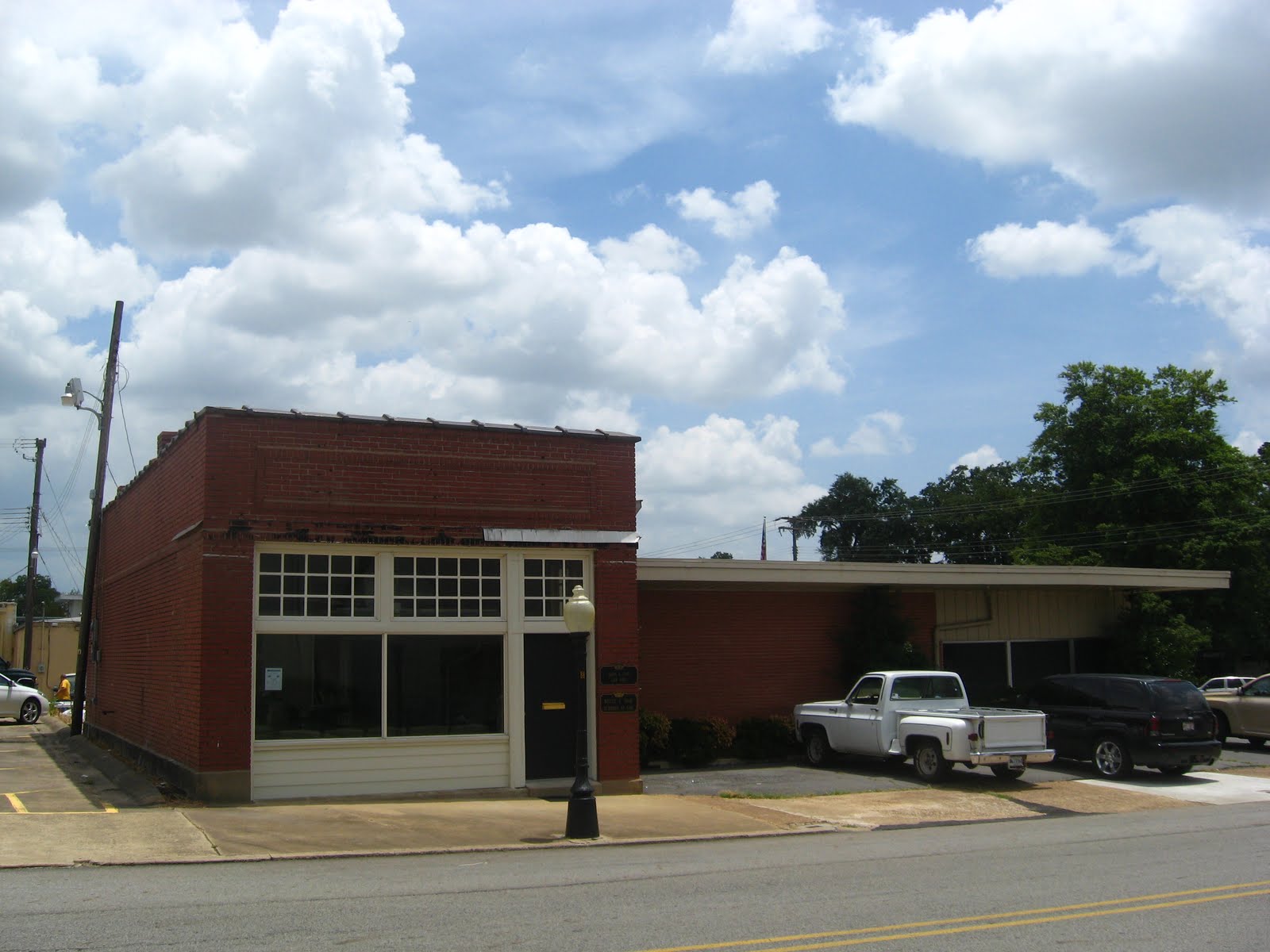
The Rock Island depot was turned into a car dealership for a while in the 1960s, but sometime in that period it was demolished. Here is the same location now from the above picture:


The brick building on the left is a law firm, but if you study the historic photograph, you can see that it was once a ticket office.

By far the most ironic thing to me about these buildings is how Searcy struggled to get the railroads to notice it while other towns nearby like Kensett, Judsonia and Beebe reveled in the major arteries passing right through them. But now nobody goes to Kensett, Judsonia or Beebe, and they still have those rails.

Hm.

-Jonesy

Setting the Tracks Straight: II

Continuing in the discussion of Searcy's depots. I don't know which of the other two came first, but I can definitely tell you which one was demolished first. The Missouri & North Arkansas line, which I've also discussed several times before, was a north-south line from Eureka Springs to Helena. It was plagued by a cluster of developmental problems, and ceased operations through Searcy in the mid 1940s.


The quaint little wooden depot was characteristic of the M&NA. Few of them still remain. The picture was probably taken around 1905 or so - take a look at the horses and folks. A passenger car very much like the one picture is on display in Bald Knob. Almost no evidence of this part of Searcy remains to this day.

But, if you walk down Mulberry Street, the little spur road off of Beebe-Capps and Main, you might notice some rails poking through the asphalt. This is the old M&NA roadbed. A few other bits of evidence still stand nearby, like loading docks on sheds and the ruins of an old motel.


I'm not terribly certain, but I have a hunch that the old Kelso Feed Store stood in the same place the M&NA depot was. It was demolished about a month ago after a long period of neglect and abandonment.

-Jonesy

Setting the Tracks Straight: I

I keep coming back to the Searcy depot.

My problem was, I didn't realize it should have been depots, the plural. In the late 19th century, Searcy was bypassed by the major railroad (the Cairo & Fulton, at the time). Town leaders struggled to get the live-giving metal rails to pass through this town, and they finally did - but Searcy was still a bit off the beaten track. So at various times, Searcy had three unique railroads, each with their own station, passing through.

1. The Doniphan, Kensett & Searcy Railroad

This was the first railroad to make it through the town, and it was an extremely short line. "Doniphan" doesn't even really exist anymore as a town, being mostly just a location between Searcy and Kensett. In its early days, the DK&S was a wooden tram line between Kensett and Searcy.

Oh, and no locomotives traveled it. Instead, passengers rode on a flat cart pulled by mules. Yep.

Here's that depot:


The DK&S went through multiple owners and identities, finally being absorbed by the supermassive Union Pacific Railroad. Ironically, though it was the smallest railroad in town, it's the only one with any tracks left. The tracks leading down Park Avenue past the Cloverdale area is the original roadbed leading from Kensett.

In fact, it's probably because Upac owns the building that it still stands today:


The wooden surface sticking out on the left is the freight loading dock. It would seem that the DK&S building was once about twice as long, judging by the older picture, but it was never the town's most glamorous station. This area was once the town's booming industrial area, home to strawberry packing and a prosperous shoe factory.

Two more to come!

-Jonesy