Showing posts with label train depots. Show all posts

Monday, November 5, 2012

Orphaned Frisco Passenger Depot, Fort Smith

Google Map
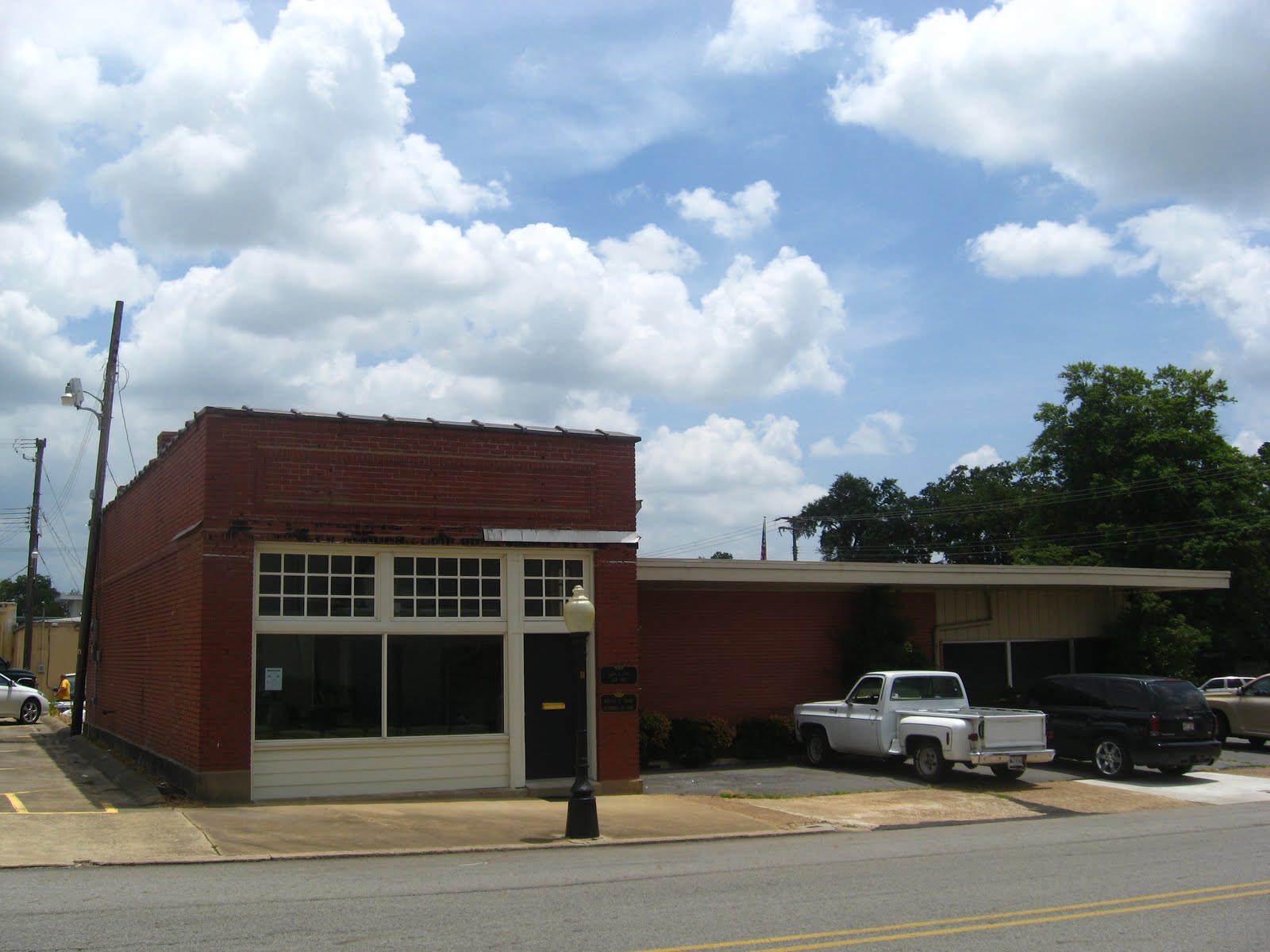
 Just near the edge of the Arkansas River sits this relic of the old Frisco line. Trains still rumble by along the river, but no one's going for a ride these days. The building is in good shape and is used as temporary offices for the planned U.S. Marshals Museum. More pics after the jump.


Wednesday, October 10, 2012

Marooned Passenger Station, Carlisle

Google Map
Carlisle, Arkansas, is located right along the old Rock Island Railroad. In 1931 (to pick a random year), you could board a train in downtown Little Rock and go straight to Carlisle. Now, the town is bare of railroad, but the old passenger station remains - in remarkably good shape. Some more photos after the jump.


Tuesday, October 2, 2012

Restored Rock Island Depot, Lonoke

Google Map

Our drive along Highway 70 paralleled the old Rock Island railroad. Many of the towns along the highway had beautiful depots in outstanding conditions. Lonoke's in particular was in excellent condition and had been turned into a modest museum with meeting spaces. It's a 1915-or-so structure built to replace a late 1800s depot that burned. A photo of the interior after the jump.


Wednesday, December 21, 2011

Snapshot - Staircase ruins, Poplar Bluff, Missouri

Google Map
An ornate staircase built across from the Poplar Bluff train station in the early 1900s. The stairs were a symbolic gateway between the railroad and the heart of the city - and you can see how long that symbolism lasted. The station is similarly dilapidated.

Saturday, December 10, 2011

Lost Empire: Rock Island Railroad

In the glory days of railroading, multiple passenger lines crisscrossed through cities. The Rock Island Railroad wound its way from Rock Island, Illinois, down south through Arkansas. Here in Little Rock, Rock Island built a huge span over the Arkansas River.

Google Map

But in time all empires must crumble.

Monday, November 15, 2010

Setting the Tracks Straight: III

At last, the most glorious of Searcy's depots!

The Rock Island railroad originated in a town of the same name in northern Illinois. I believe the part that came through Searcy was a spur that terminated right at the edge of downtown. The depot was right across the street from Spring Park, a destination for many travelers to Searcy in its pioneer days.


The Rock Island depot was notable because it was brick and expensive. No one was really sure why the railroad built such an extravagant building in Searcy, because the town wasn't exactly a major destination for the railroad, even with the sulphur spring. But build it they did.

I love to imagine the geography and feel of the town when all three of these railroads were operating in its borders. Imagine hearing those steam locomotive whistles every few hours? And being able to hop on a wooden M&NA car and taking a scenic trip up to Pangburn or Letona? Assuming it came in on time.

The Rock Island depot was turned into a car dealership for a while in the 1960s, but sometime in that period it was demolished. Here is the same location now from the above picture:


The brick building on the left is a law firm, but if you study the historic photograph, you can see that it was once a ticket office.

By far the most ironic thing to me about these buildings is how Searcy struggled to get the railroads to notice it while other towns nearby like Kensett, Judsonia and Beebe reveled in the major arteries passing right through them. But now nobody goes to Kensett, Judsonia or Beebe, and they still have those rails.

Hm.

-Jonesy

Setting the Tracks Straight: II

Continuing in the discussion of Searcy's depots. I don't know which of the other two came first, but I can definitely tell you which one was demolished first. The Missouri & North Arkansas line, which I've also discussed several times before, was a north-south line from Eureka Springs to Helena. It was plagued by a cluster of developmental problems, and ceased operations through Searcy in the mid 1940s.


The quaint little wooden depot was characteristic of the M&NA. Few of them still remain. The picture was probably taken around 1905 or so - take a look at the horses and folks. A passenger car very much like the one picture is on display in Bald Knob. Almost no evidence of this part of Searcy remains to this day.

But, if you walk down Mulberry Street, the little spur road off of Beebe-Capps and Main, you might notice some rails poking through the asphalt. This is the old M&NA roadbed. A few other bits of evidence still stand nearby, like loading docks on sheds and the ruins of an old motel.


I'm not terribly certain, but I have a hunch that the old Kelso Feed Store stood in the same place the M&NA depot was. It was demolished about a month ago after a long period of neglect and abandonment.

-Jonesy

Setting the Tracks Straight: I

I keep coming back to the Searcy depot.

My problem was, I didn't realize it should have been depots, the plural. In the late 19th century, Searcy was bypassed by the major railroad (the Cairo & Fulton, at the time). Town leaders struggled to get the live-giving metal rails to pass through this town, and they finally did - but Searcy was still a bit off the beaten track. So at various times, Searcy had three unique railroads, each with their own station, passing through.

1. The Doniphan, Kensett & Searcy Railroad

This was the first railroad to make it through the town, and it was an extremely short line. "Doniphan" doesn't even really exist anymore as a town, being mostly just a location between Searcy and Kensett. In its early days, the DK&S was a wooden tram line between Kensett and Searcy.

Oh, and no locomotives traveled it. Instead, passengers rode on a flat cart pulled by mules. Yep.

Here's that depot:


The DK&S went through multiple owners and identities, finally being absorbed by the supermassive Union Pacific Railroad. Ironically, though it was the smallest railroad in town, it's the only one with any tracks left. The tracks leading down Park Avenue past the Cloverdale area is the original roadbed leading from Kensett.

In fact, it's probably because Upac owns the building that it still stands today:


The wooden surface sticking out on the left is the freight loading dock. It would seem that the DK&S building was once about twice as long, judging by the older picture, but it was never the town's most glamorous station. This area was once the town's booming industrial area, home to strawberry packing and a prosperous shoe factory.

Two more to come!

-Jonesy

Monday, November 8, 2010

Pioneer Village II: Garner Depot

Going on with the Pioneer Village. This is my favorite piece in their collection, and anyone who reads this blog can probably see why.


This beautiful depot once stood in the desolate town of Garner, which lies a few miles south of Searcy. It's an odd duck, because none of the depots that once stood in the villages bordering Searcy (Kensett, Judsonia, Higginson) still stand. But it's probably because of its unusual history that we still have it.

The Missouri-Pacific Railroad ceased passenger railroad activity from Garner in 1939, moving it instead to neighboring McRae. To avoid confusion, the railroad ordered that the depot be moved from the railroad. These days, it probably would have been demolished instantly, but back then the people of Garner had other ideas.

It was moved across the street (pausing in the middle of the highway overnight), then converted into a residence. Years later, a family from McRae acquired it and moved it onto their property, where they operated an antique shop out of it.

Eventually, those owners passed away and the next of kin offered the building to the White County Historical Society. They packed it up and moved it to Searcy, where it remains to this day.

The 1888 building shows the sort of character that public transit buildings had in those days, and gives us a rare glimpse of what small-town depots were like.

-Jonesy

Sunday, October 24, 2010

Artifacts Anonymous

My name is Luke Jones, and I'm an artifactaholic. And I have no plans to change! HA!

Today's artifact is still the M&NA railroad. We previously discussed the sad shape of Pangburn's rail center. I found an archival photograph of the same building:


This was taken in 1921, still a good 28 or so years before the railroad's ultimate demise. Apparently the M&NA wasn't exactly the world's most favorite railroad. To many, the letters more accurately stood for "May Never Arrive," but if you had to get to Pangburn or Letona or one of those other little burgs you had to grit your teeth and take it.

I read an account (from the White County Historical Society) where a man remembered the wood stove on his passenger car running out of kindle and some brave or crazy men jumped out of the car and tore some boards right off of the depot.

But when M&NA engines broke down too much, oftentimes they would end up in Kensett. Yes, the little hamlet called Kensett was a major intersection for M&NA trains back in its day. It's a sad place now. A man who grew up there told me the other day, "Wal-Mart killed this town."

But the M&NA had packed up and left probably before Sam Walton had been kicked out of Newport. So the rail ruins of the M&NA have had a long time to become part of the scenery. The same man who dictated Kensett's death showed me these:


On the edge of someone's property on a back road in Kensett are these unusual concrete ruts. I was absolutely delighted to learn that they are the ruins of the M&NA locomotive shop! There may have been a complete structure built over these ruts at one point but now the concrete structures poking through the ground are all we have.

The "teeth" on the edges of the trenches once held cross ties between them (a few are left). Locomotives would roll over the pit and workers could slide under there and make repairs. This must have been a major stop for the M&NA, because there are two more bays:


Across from the bays are some more ruinous bits that are impossible to identify:


I find it amusing that the roadbed leads right up to the ruins of an old barn, which in turn doesn't seem to be used for its original purpose. The discarded farming equipment along the repair bays leads me to believe that prosperity hasn't been seen in this part of Kensett for a long, long time.

-Jonesy

Tuesday, October 19, 2010

Derelict depot

There's a certain amount of pleasure in finding a town's old train station in an odd place. Many of the smaller towns in Arkansas were served by the Missouri & North Arkansas line, an up-and-coming railroad that had a depot in Searcy in its day.

Unfortunately it made the mistake of following the Mississippi River instead of going to Little Rock. A man who's studied the rise and fall of the line told me that if they had gone to Little Rock, they might still be around today.

But they aren't. Their thinking was if they followed the might Mississip, they would get all of the commerce along the way. But commerce along the river died halfway through the 20th century, and so did the M&NA.

The M&NA literally created some towns, including Pangburn. This little burg lives right at the border of White County and had its heyday with the railroad. The old commercial sector is mostly gone now, just one single block of 19th and 20th century brick buildings left.

And the old depot...well, see for yourself.


Actually it's fairly rare that a small town has been able to keep its depot at all. Most tiny towns like Kensett, Judsonia, McRae and Garner all had depots at one point but they were sacrificed for various reasons. This one, though, managed to tough it out.

It has been a private residence for many years and the other side of the building is still covered in dismal vinyl siding and is barely recognizable as a train station. But the owners recently peeled the siding off on this side and the beautiful Italianate style has come through once again. It's still in pretty hideous shape, though.

I've heard there are plans to restore the building, but I never hold my breath for this type of thing. I hope, I hope, I hope, but we'll see. In the meantime, enjoy it while it lasts.

-Jonesy

Wednesday, April 21, 2010

Some more railroad dreams

I've talked about Mt. Carmel before. I've been there exactly as many times as I've been to Albion, Jenna's town, because that's where both her church and her grandmother are. It's also where her mother grew up, and her mother's mother, and her mother's mother's mother...

And, like most small American towns, the railroad was once the pump of its bloodstream. Driving into the town I always would notice this huge brick complex:


I always thought it was once a factory or some other source of labor for the city--and I was right. Take a look at this:


Same place, different time. The present buildings are visible in the top-right of the photographs. The brick hulk is the main shop of the Big Four Railroad Yard, which as you can see was a pretty major railroad terminal. Nearly all evidence of the tracks have disappeared; a few still pass through the town in unrelated areas. Around the back I found a few stragglers:


This grandfather of railroad prosperity is, I'm sure, full of tales. Big Four was where trains came for industrial needs, but wasn't a place for passengers.


This Italianate depot resembles the depots of just about every small town ever, but it no longer stands. Mt. Carmel received a much fancier terminal in 1905, and a little wandering will lead you to its doors.


The 1905 depot is an unusual 2-story affair that more resembles a household than a train building. It stands just a few blocks away from the former Big Four area, sandwiched between downtown Mt. Carmel and its orbital neighborhoods (full of incredibly beautiful houses and brick streets, I might add).


Here's the building as it appears now, standing upon its little yellow-bordered cement island in the middle of a parking-lot pond. It's currently used for office space, but hey, at least it's in use.


This is the loading dock side. Where the passengers would once have lined up, waiting for passage, folks now sit outside on some dated 1970s vinyl chairs and eat a light lunch. If you look at old pictures above, you will see some bridges crossing the old right-of-way: these bridges are no more. In fact, there is no evidence of tracks whatsoever. Just another town marooned from the railroad.

By the way, here's some news. In about a month--I am very pleased to say--I will be taking Amtrak from Little Rock all the way to San Antonio for a wedding. You have no idea how excited I am to be on a train for almost 20 hours. I am VERY excited. Okay see you later

-Jonesy

Tuesday, December 29, 2009

Last Train to 2010

The winter marches on, and we're back again to the subject of trains. This is a good train story, though: no lamenting over buried tracks or abandoned right-of-ways or derelict depots. No, sir.

This is about the Arkansas-Missouri Railroad.

But first, Van Buren!


Van Buren lies just north over the river from the much larger city of Fort Smith. Van Buren is like Fort Smith's kid brother. Unfortunately, Fort Smith got into drugs and carousing and general raucous behavior, while Van Buren kept itself under a warm hat of responsibility and historical self-respect. What I'm trying to say is, its downtown is ever so much more beautiful than Fort Smith's, even though the latter town used to be some kind of breathtaking destination-town. For example, the above building (probably Van Buren's most famous) is an 1889 bank building that resulted from a feud between two bankers: since in the late 19th century the complexity and beauty of brickwork was indicative of a business's prosperity (and now you shouldn't be wondering why I am nostalgic for such times), one banker just up and built a bank right next to his rival's, only built his to be as architecturally marvelous as possible.

As it happened, none of it would really matter. Neither the "Crawford County Bank" nor the "Citizen's Bank"--the smaller of the two buildings, belonging to the other rival--managed to pull their business into the 21st century. Both of them (as well as the even older bank across the street) lost out to some bank buildings that probably didn't even use bricks.

But in the end, Van Buren got to keep its built environment, and the Crawford County Bank now adorns all of the little "Visit Downtown Van Buren" brochures. Fort Smith, on the other hand:


They sacrifice their built environment so ten more people can park their cars on a Friday afternoon. Oh, sure, they left the pediment and some of the pilasters of this building so people (like me) can see them and just wonder what used to be there. The face remains, like the only piece of a shattered family heirloom we can't bear to throw away.

But let's get back to the matter at hand. Whatever railroad depots and tracks and excellent things Fort Smith had are long gone. Van Buren's, however, are not only still standing, but are still quite in use:


Yes, it's your average Italianate depot with the addition of a mission-style shingle setup, much the same as many of Arkansas's smaller towns', but the presence of a sizable crowd is what makes the difference. And what's that? That thing just to its right?


Ah yes. A train. The Arkansas-Missouri Railroad is a small, privately owned line operating out of western Arkansas and southern Missouri. Like the Maine Eastern Railroad, the Arkansas-Missouri operates a freight line as well as a passenger excursion line. They have a number of different excursion packages, stopping in little towns up and down the west edge of Arkansas. We could have chosen one with a seat in a caboose, or one with an acted-out train robbery (complete with blank-shooting pistols). We chose the one that went from Van Buren to Winslow and turned around. Not the most exciting, but take a look at the inside of the car:


It's vintage 1920s. The seats were springy, but did we care? The car is a relic of a time when care went into the making of everyday objects, transforming mundane environments into ones of beauty. Of course, a family trying to get from Little Rock to Memphis because their grandmother is about to die probably would not care if the car was just a steel box, and sure, anyone who sees the same beauty every day might forget it exists.

I wouldn't, though. The sublimity of the car and our surroundings transfixed the four of us (me, Jenna, Drew and Kelsey Spickes). The trip took us through little towns, shallow gullies, cages of blasted granite, pitch-black tunnels, deep gorges at the bottom of which lie the bones of the American telegraph network...

The conductor on our car was an old man, hard of hearing but full of stories. He told us about the train trips he would take in his early childhood on this same route, stopping at the tiny depots every town once had. Each station would only yield a person or two, if any, but one thing was guaranteed: the train would load bottles of milk from every depot. This was an image burned in his mind.

The little towns we chugged through weren't so notable except for an anecdote or two the conductors would relate here and there. Winslow was little more than an arbitrary place with an extra track to turn the train around. But one town I will always remember: Mountainburg. Here's why.

There are three towns in Arkansas that start with the word "Mountain." They are Mountain Home, Mountain View, and Mountainburg. Mountain Home is famous for being the Arkansan version of Florida: old people go there to pretend the rest of the world doesn't exist. Mountain View is famous for attracting musicians from not just around the state, but from around the country, and for just being all around one of the best towns ever. Mountainburg is famous for dinosaurs.

Yep. When we passed the dust-mote sized hamlet, our conductor told us what he used to tell passengers about Mountainburg: "I used to say it was the only place in Arkansas you'd find dinosaurs," he said. "Then I found out about this place up north that has 'em too." Well, the "place up north" is, of course, the late Dinosaur World, but that's too tangential to go into now.

Mountainburg has two dinosaurs. Click here to see what they look like. We could just make them out from the window of our car, and that little glimpse made my day. Of course, the train had already made my day four or five times over, but hey, you know.

Seems like I need to wrap this story up. The funny thing is, I actually enjoyed this train trip more than the one in Maine. Something about the scenery, the antique car, the food, the conductors...it was just better. One more leisure railroad remains for me to encounter in Arkansas, and my ultimate goal still stands: ride a steam locomotive. All in years to come. Don't touch that dial.

In the meantime, I bid farewell to 2009. It has been a good year for Time Fishing. Maybe not so consistent, but good nonetheless. I look forward to fishing in 2010...

-Jonesy
P.S. Take a look here to see pictures of dinosaur statues all over the country. This is awesome.
Tuesday, November 17, 2009

Railroad Hamlets


"All across America, hamlets grew into towns, and towns into cities, with the coming of the railroad; and with the going of the railroad, cities faded into towns, towns into hamlets, and hamlets into ruins. As if it were a vessel supplying blood to the brain, the shutting off of the railroad brings on stroke, paralysis, and death..."

--Donald Harrington, Let Us Build Us a City

But the real blood flow in these towns and cities wasn't actually engines, cars, or cabooses: it was people. And the blood, the people, would exit and enter the railroad cars into the bloodstream of America by way of depots. I've been here before--to train stations--and I've returned again. The first few are all remarkably similar to each other, and all three are conspicuously located along U.S. Highway 64 (a new, rerouted vein).


Russellville's depot stands proud on a podium of pristine concrete, surrounded by curving sidewalks and pedestrian statues crystallized in bronze. It's the center of attention in a downtown restoration not, hopefully, just limited to Russellville. The station, like the other two on 64, still commands its own section of tracks, but no passengers have boarded a train from this station in probably 50 years.


Continuing to the west, Morrilton (the aboriginal location of Harding University) wields a dusky downtown and another Italianate station, this one converted into a geneology museum. The station, like Russellville's, owns its own little section of sidewalk with brick borders and immobile wooden benches. Do festive Morriltonians inhabit these benches at any time? During our short stay in the town (near twilight), we spied no pedestrians.


The last stop on highway 64 is Atkins. Though Atkins' station is quite similar to the other two, it has been left high and dry on a slough of gravel and weeds, separated from its blood vessel by a rude wire fence. The station does not seem to be home to any organization in particular, but it does bear the town's name and appears to be in generous upkeep.

In a different direction, in the north part of Arkansas, south of Harrison and north of Conway, we find a true railroad hamlet: Leslie.


Even in 1950, the town's depot was forlorn and probably mostly empty of red blood cells. Leslie was legitimately a town that was born and died with the railroad; in the early 20th century, it was the end of the line, with only steeper grades reaching northwest beyond. Its population doubled and redoubled and re-redoubled until it teemed at nearly 10,000, a gurgling mass of industry, entrepreneurs, and--no doubt--gallons of hard liquor. But the industry left with the railroad, and the population finally tumbled down to around 500 today.


I had to blink and rub my eyes a couple of times before I decided that yes, this was a train station, and yes, trains once did chug their way this far into the mountains. But they do not anymore, and Leslie's depot is now embargoed into the property of a local lumber company. Stripped of its passengers, its rails, and its dignity, the building probably does its best to hide its original, all-important identity.

Leslie's is not a story of failure, however. The little town is just off the beaten (automobile) track towards Harrison and Eureka Springs, and has managed to save their downtown from desolation, instead transforming it into a pleasant, antique-store laden diversion. It's also home to a few cafes and a renowned privately-owned bakery.

Each of these towns with their stations reminds me of a time when cars did not own our lives, and gives me a little (just a little) hope that one day we may pluck them from the hands of the lumber yards and historical societies and cobwebs to supply that energizing lifeblood again.

-Jonesy

Sunday, July 26, 2009

The Maine Eastern Railroad

Young Luke was a homeschooled lad. Motivating children to educate themselves takes a little bit of incentive, and my mother was pretty good at that. One of her solutions to this problem was the "mailbox item," in which she would place a small reward-item in a wicker basket attached to her bedroom door. When I finished my work for the day, the mailbox item would be mine. The prizes ranged from candy to small toys. But one day, I reached into the basket and found a ticket with a brochure. Upon the brochure was a photograph of a dynamic green-and-yellow diesel locomotive.

I knew this train because we had seen it crossing the tracks at Wiscasset, a little village we had to drive through to get to Brunswick or Portland. It was a leisure train, just operating for the sake of the ride. But I didn't know that, all that mattered is I got to ride it.

Something like 15 years later, while Jenna and I were on our honeymoon in Maine, I remembered that train. I decided to see if it still existed.


It did.

A little bit of internet research yielded the name of the railroad, the Maine Eastern Railroad, and a travel schedule. The trains ran from Brunswick to Rockland, a distance of about 50 miles.


The railroad's stop in Brunswick was little more than a gravel parking lot with a tiny wooden kiosk serving as a station: Brunswick's original station is long gone (much to my surprise; most historical buildings in Maine are revered). The railroad usually offers a dining car and a first-class car, but as this was the train's first weekend of service for the season they hadn't gotten those yet. We were treated to the standard passenger car.


For all I've said about the superiority of train travel, I...was pretty much exactly right. The car was so much more comfortable than really any kind of transportation I've ever experienced, except for maybe charter buses. A lot better than first-class air travel, even. The cars were air-conditioned, roomy and offered a look at the beautiful countryside and towns of Maine. As we got going, many of the residents of Brunswick stopped to stare and wave at us. I heard someone from the rowdy group of 40-somethings at the other end of the car say, "Let's be like the tourists and wave back!" So I did.


The train first stops in Bath, a former hometown of mine. Bath's station still stands (seen above) and was recently refurbished for the purpose of the Eastern Railroad. I asked one of the conductors about the history of the railroad, and he told me it had only been open a few years. But the trains, he said, have been operating on and off for a long time. So I must have ridden it at one of those intermittent times. We picked up a couple passengers in Bath, and then crossed the ghostly Carlton Bridge and made towards Wiscasset.

Wiscasset's station was a diminutive building resembling a standard Italianate depot, but looked like a hasty reconstruction to me. Nobody boarded the train at Wiscasset. A few of the 40-somethings yelled their affection for Red's Eats, a famous hot dog and lobster roll stand in the town.

The rest of the train ride was a beautiful 2-hour meander through the countryside of Maine. The track was lined with decaying telephone poles, some with wires drooping towards the ground. Occasionally we passed through a town, at least one having an abandoned train station. I spotted a few derelict Amtrak cars on a side track as we got close to Rockland.


Rockland's station is not only present, but completely renovated. One side of it is home to a Maine Eastern Railroad office and gift shop, and the other side is a new restaurant/bar.


We decided to eat lunch here, and I ate probably the most immense Reuben I've ever seen. The group of 40-somethings all plopped themselves down at the bar, and we left them there in favor of exploring Rockland for a couple hours before catching our return train.


Rockland is a formerly industrial town which has managed to clean up its image a little in recent years. It's home to the Wyeth-saturated Farnsworth museum, which was recommended to us by almost everyone in Maine. It has its supply of interesting shops and waterfront activities. We enjoyed them for a few hours and then got ready to board our train again.

Upon getting in our seats, we noticed some of the members of that group of 40-somethings were stumbling back onto the train.

It turned out the only reason they were in Rockland was to bar-hop in celebration of one of their friend's birthday. The purpose of using the train was to avoid having to select designated drivers. Our eyes widened as they all started pulling out giant cases of beer and hip flasks. This made it a little difficult for us to enjoy the scenery on the way back...

One of the group, probably the most drunk of them all, was a very loud woman who seemed to think Jenna and I were European (because I had made the somewhat foolish choice of wearing a suit for the trip, and because we didn't talk that much). She was positively riotous once she found out I was actually from Maine, and thereafter would, from time to time, pop into our booth, tug on my gold tie, and tell me, "You know--you know what? You're GOLDEN." This happened frequently until her friends started trying to hold her down. She could still be heard up and down the train informing various folks, "Hey! It turns out they're not European!"

Another guy in her booth tried to offer us booze a few times, but as it was like two or three in the afternoon, and since we're too snobby for Bud, we politely turned down his offers. His reaction was to ask us if we were born-again Christians, which we are. Once he knew that, he would go off onto little anti-Christian rants sort of to himself but sort of to the people in his booth at the same time. We could hear him, of course. Pleasant.

After ten or twenty drunken rounds of "Happy Birthday" and one passenger's complaint against the increasingly unruly 40-somethings (followed by another grumbling rant by our anti-Christian friend), we managed to make it back to Brunswick.

So did the behavior of our drunken car-mates make our train trip across Maine less awesome? No. No, it didn't. It just gave us a good story to tell. And it made me more ready for the return of train travel.


-Jonesy

Wednesday, July 8, 2009

More Train Stations


I have, of course, been dutifully snooping out train stations wherever I go. This continued snooping revealed to me that I have led you, the readers, astray! Yes, the building at the corner of Beebe Capps and Main that I mentioned in a previous post is NOT, in fact, the Searcy train station. It is undoubtedly a former train building (as the nearby tracks and loading docks declare), but the actual depot lies just a few feet away on Main Street. It is so devoid of visible train-features that I have missed it up until now.


The depot, the last remaining of (I think) three depots which once stood in Searcy, is a completely unassuming building. In hindsight, it displays many more of the qualities of a depot than the larger building on Beebe Capps and Main, but is much smaller than even the depot in Bald Knob. I'm not sure if this is representative of Bald Knob once being a more prosperous city, or if it just means a smaller railroad owned this depot (I know for a fact that it wasn't owned by Missouri Pacific, for example). There is a rustic wooden loading dock hidden away on the side of the building, visible only for those with hawk-like eyes for railroad paraphernalia. Not me, in other words. Here a couple of different views of the building:


Though the decrepit nature of the depot would seem to indicate its vacancy, this sign near the front door claims otherwise:


While I don't see Searcy's railroad potential going up any day (or year) soon, this depot makes me just a little more hopeful.

I'm not done yet, though; there are a few more depots to talk about.


A much earlier trip to Newport, Arkansas (original stomping ground of one Sam Walton; more on that another time) revealed their gorgeous and well-maintained train station in an otherwise moldering downtown sector. Like most depots in this area, it's in the traditional Italianate style, complete with large decorative brackets. I would postulate that the depot in Searcy had brackets at one point, but given its present condition, nobody really cared to maintain them. The depot seems to be home to some sort of meeting/event hall these days, but the trappings of railroad life lie all around it. Here are some more views:


The last station I'd like to talk about is one of the largest I've seen in my life. It's Union Station in Little Rock.


According to Amtrak's web site, Little Rock's Union Station was built in 1921 after a fire destroyed the original building. It also once held a record for being the largest station hosting only one railroad. As you might have gathered, it's the first station I've mentioned on this site which is actually still in use as a station. Amtrak loads its intermittent passenger cars from here, with it and Walnut Ridge being the only two stations left in operation in Arkansas. Boo. I don't have an altogether wonderful picture of Union Station in its entirety, so here's a link to Amtrak's page on it. Meanwhile, enjoy another picture of the station's magnificent tower.


-Jonesy